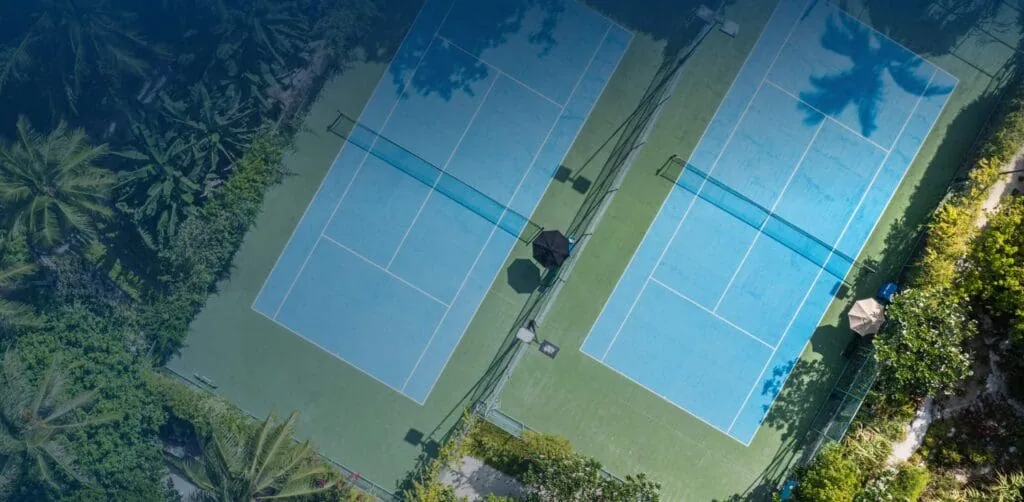
From the crisp lines to the eye-catching colored surface, tennis court construction takes careful planning under the surface, from preparing the site to building the right base and managing drainage.
If you’re planning a tennis court project for a school, HOA, club, municipality, or commercial property, those early decisions shape the scope and estimate you receive. At Pro-Pave, Inc., we provide tennis court construction and commercial paving services in Northern Virginia and Washington, D.C.
Before you start comparing proposals, we’ll break down what goes into professional tennis court construction services, what affects the cost, and what to look for in a tennis court contractor.
Tennis Court Construction Requirements
Standard tennis court dimensions are 78′ × 27′ for singles and 78′ × 36′ for doubles, based on USTA specifications. You’ll need additional space beyond the playing lines, so we look at the facility design and intended use when evaluating the overall footprint.
Before construction begins, we evaluate the site’s grading, drainage, soil and base conditions, and equipment access. Tennis court construction planning accounts for how water will move away from the court rather than collect on or around the playing surface.
Permitting and zoning requirements vary across Northern Virginia and Washington, D.C., so we’ll identify what applies to your property early to avoid unexpected changes to the project scope.
Tennis Court Base and Surface Options
The finished color is only the top of the system. Your court also needs a structural base suited to the site, followed by the surface system that determines the final playing conditions.
Asphalt Base: Asphalt is commonly used as a base for outdoor sport surfaces. The prepared sub-base provides the stable foundation needed before installing the asphalt.
Post-Tension Concrete: Post-tension concrete uses tensioned steel tendons within the slab to help manage concrete stresses. We provide post-tension concrete services for commercial projects, but whether your tennis court base needs it depends on site conditions and project design.
Acrylic Surface Coatings: The acrylic coating system goes over the prepared structural base to create the finished playing surface. We offer specialty coatings in different colors and finishes to suit the facility and court design.
What Does Tennis Court Construction Cost?
As a general market estimate, tennis court construction cost often ranges from $25,000 to $120,000. Your estimate will account for site preparation, drainage, the base and surface system, and any existing court removal, along with additions such as fencing, windscreens, lighting, or accessibility improvements.
If you have an existing tennis court and the pavement underneath is still in good shape, resurfacing may be enough to give it a fresh start without rebuilding from scratch.
The Tennis Court Construction Process
Prepare and Grade the Site: We clear and grade the area according to the project design and planned drainage.
Prepare the Sub-Base: We prepare the sub-base to create a stable foundation for the court.
Install the Court Base: We install the specified asphalt or concrete base according to the project requirements.
Apply the Surface System: Once the base is ready, we apply the acrylic coating system in stages, allowing for the required drying or curing time between applications.
Stripe and Finish the Court: We finish the court with court paving and line marking services.
How to Choose a Tennis Court Construction Company
Before choosing a tennis court construction company, check their reputation and make sure you understand everything included in the estimate.
Ask for examples of similar sports construction projects to confirm experience with athletic surfaces.
Discuss existing site and drainage conditions and how they factor into the proposed work.
Verify that the contractor carries the licensing and insurance required for your project and location.
Compare proposals based on the full scope, including site preparation, materials, surfacing, striping, and any additional features.
Review warranty terms so you know what is covered after the project is complete.
Pro-Pave, Inc. brings commercial paving and tennis court construction experience to projects throughout Northern Virginia and Washington, D.C. We’ll make sure you understand the scope of work before construction gets underway.
Contact our team for a quote, and let’s put your plans to pavement.
Tennis Court Construction FAQs
How Much Does It Cost to Build a Tennis Court?
Tennis court construction costs vary depending on site preparation, drainage, the court base, surface system, and added features such as fencing or lighting.
How Long Does It Take to Build a Tennis Court?
Your construction timeline will depend on the amount of site preparation, weather, the selected base and surface system, and required curing or drying times. Once the site conditions and scope are established, your contractor will provide a project-specific schedule.
What Is the Most Affordable Way to Build a Tennis Court?
A straightforward court design with fewer optional features, such as lighting or windscreens, generally keeps the initial cost lower. However, the base, grading, and drainage still need to match the site conditions. Cutting back on that preparation to reduce the upfront price may lead to pavement problems later.
When Does a Tennis Court Need to Be Rebuilt Instead of Resurfaced?
Resurfacing is generally better suited to a court where the underlying pavement remains structurally sound, and the problems are limited to the surface. If cracking, settlement, or drainage issues point to problems below the surface, the court may need more extensive repairs or reconstruction before resurfacing.